
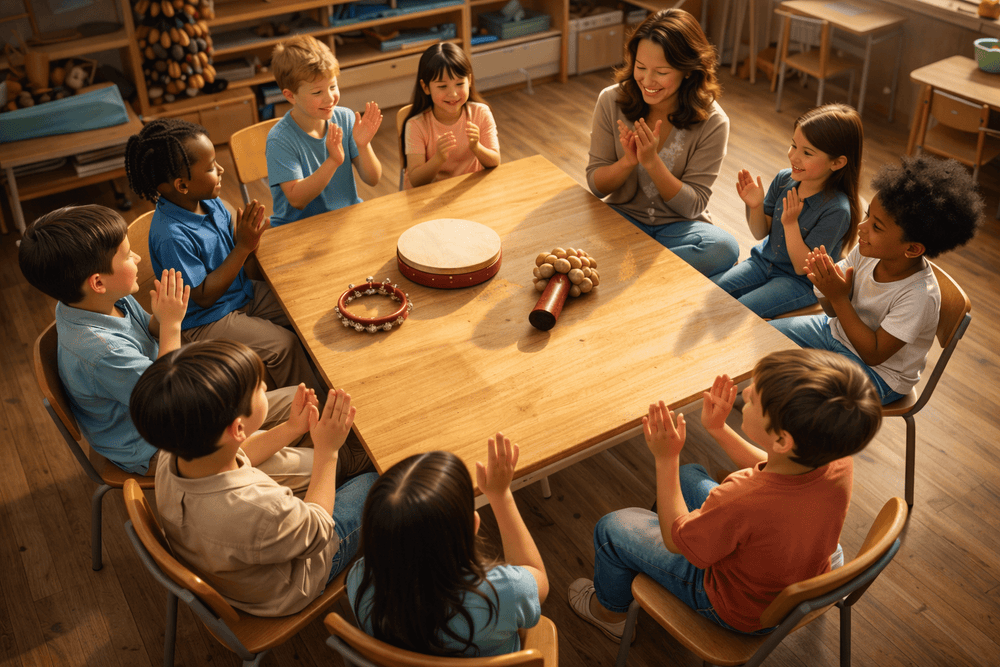
A classroom can transform in minutes. Not because rules suddenly become stricter, but because attention shifts. Many teachers have discovered a surprisingly effective way to guide that shift: simple music-making.
You don't need a stage. You don't need long rehearsals. With the right activities and a few classroom-friendly instruments, teachers can help students settle, listen, and move as one group—often in under five minutes.
Why Music Helps Students Focus
Focus isn't only a mental skill—it's physical and social. Students learn to focus when their bodies have clear patterns to follow and when their attention has a shared target.
Rhythm-based activities create that target quickly. A steady pulse gives the classroom a common "center," and students naturally begin to coordinate their movement and listening around it. This coordination reduces chaos and supports calm participation.
If you're curious why rhythm feels so natural for children, you may enjoy this related post: Why Rhythm Is Often a Child's First Language.
What "Simple Instruments" Really Means
In this context, "simple" does not mean low-quality. It means instruments that:
- • Make sound immediately, without complex technique.
- • Support group timing rather than solo performance.
- • Are easy to distribute, collect, and store.
- • Stay consistent in sound, even with beginners.
Teachers often choose instruments that can be used for warm-ups, transitions, and quick group exercises—because the goal is not perfection, but participation and listening.
3 Classroom Moments Where Music Works Best

1) The "Arrival Reset" (First 3–5 Minutes)
When students first enter the room, energy is scattered. A short rhythm routine gives them a clear task and a shared pace. Instead of asking for silence, teachers offer a pattern that students can follow.
2) Transitions Between Activities
Transitions are where many classrooms lose momentum. A simple call-and-response rhythm can move students from one task to the next without raising volume or repeating instructions.
3) Regaining Attention After Group Work
After group discussions or hands-on activities, students may struggle to re-center. A short, coordinated music task helps them return to shared listening—fast.
A 5-Minute Rhythm Routine Teachers Can Use Tomorrow
Here is a classroom-friendly routine that works with handbells, simple percussion, or any instrument that can produce a clear sound quickly.

Step 1: Establish a Steady Pulse (60 seconds)
The teacher plays a steady beat. Students respond by clapping or tapping on their desks. Keep it slow and comfortable. The goal is alignment, not speed.
Step 2: Add a Simple Pattern (60 seconds)
Introduce a short pattern such as "tap-tap-rest, tap-rest." Students repeat it as a group. Repeat until the classroom feels synchronized.
Step 3: Small Group Echo (90 seconds)
Divide the room into two groups. Group A plays the pattern, Group B echoes. Then switch. Students learn to listen closely because their entrance depends on the other group's ending.
Step 4: One "Leader" Moment (60 seconds)
Invite one student (or the teacher) to lead a variation: one extra beat, one extra rest, or a louder/softer dynamic. The class follows. This builds leadership without spotlight pressure.
Step 5: Clean Ending (30 seconds)
End with a clear "final beat" together, then silence. A clean ending teaches control and gives the room a natural pause before the next activity.
Why This Routine Works (Even for Mixed Skill Levels)
In most classrooms, students have different comfort levels with music. The strength of simple rhythm routines is that they reward listening more than talent.
- → Beginners can succeed by following the pulse.
- → Confident students can add small variations responsibly.
- → Shy students can participate without being singled out.
- → The whole group learns to stay together rather than compete.
Choosing Instruments for Classroom Success
Teachers often look for tools that support learning with minimal setup. When choosing instruments for classrooms or group programs, consider:
- • Clarity: Can students hear the beat distinctly?
- • Control: Can the sound be started and stopped easily?
- • Durability: Will it hold up to repeated classroom use?
- • Consistency: Does it sound reliable across a set?
- • Storage: Can it be organized and accessed quickly?
When instruments reduce friction, teachers can focus on what matters: creating a shared musical experience that supports attention and connection.
What We Care About at Yunicrafts
At Yunicrafts, we believe classroom instruments should make participation easier—not more stressful. We focus on tools that help groups listen, coordinate, and succeed together.
If your goal is not a polished performance, but a focused, cooperative learning moment, simple instruments can be one of the most reliable ways to get there.


