
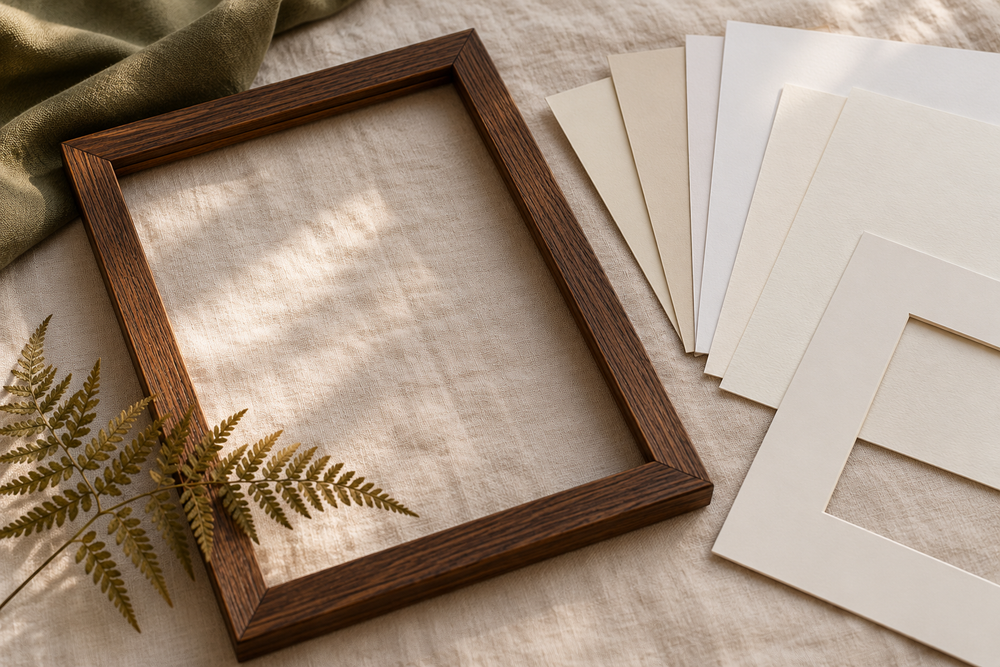
A pressed fern looks beautifully simple: a leaf, a pale background, a frame. Then the description mentions archival paper or museum-quality mounting, and a straightforward purchase starts to sound like a specialist decision. What do those words actually tell you about the piece you are bringing home?
For a buyer, archival should prompt questions about named materials and construction, not a promise that flowers will never change. Separate appearance, material information and evidence. A botanical frame can be lovely without being a conservation object. The useful question is which parts of its construction are described clearly enough for your expectations.

Archival describes more than an old-fashioned look
In everyday shopping, archival often appears beside cream paper, handwritten-style labels and botanical arrangements. Those visual details are an aesthetic; they cannot establish the composition of the backing or how the plants are attached. A vintage-looking sheet might be newly made, and a white sheet is not automatically better documented.
The Library of Congress’s guidance on photographic storage materials distinguishes acid-free, lignin-free and buffered or unbuffered paper enclosures. These terms describe different properties, not interchangeable levels of quality. The guidance concerns photographs and their housings, not certification of a retail botanical frame. It also illustrates why the material being protected matters when choosing a housing.
Use the distinctions to ask a focused question: does archival describe only the visible paper, or also the backing, mat and mounting materials? A specific answer is more useful than an extra adjective. You do not need to become a paper chemist to recognize when a description leaves the scope unclear.
Turn the label into a practical buying question
Keep the following table beside the product page. It is a way to compare the completeness of information, not a ranking of products or a test you can perform from a photograph.
| Wording you see | Ask for | Do not infer |
|---|---|---|
| Acid-free paper | Which sheet or board, and its material specification | Every part of the assembled frame has the same properties |
| Archival mounting | Backing, attachment method and material details | A guaranteed lifespan for the plants |
| UV-filtering glazing | The named glazing product and documented specification | All light damage is prevented |
| Museum-quality | The concrete construction features behind the phrase | Independent certification or scientific provenance |
| Vintage herbarium style | Whether labels are decorative and what is actually included | A historical specimen, verified identification or collection record |
Save the answer with the product description, particularly for a gift. If the seller cannot provide a technical specification, record that as an unknown. It is not proof of a poor material, but it is a reason to avoid making a stronger preservation promise yourself.
A useful reply might identify a backing-board manufacturer, explain which mounting method is used, or say plainly that no glazing test information is available. Those answers are not equivalent, but each helps you understand the purchase. If you are comparing two frames, put the same questions to both sellers rather than comparing one detailed specification with another listing’s headline.

Paper quality is only one part of the assembly
The Canadian Conservation Institute’s review of materials used in preventive conservation explains that paper may be acidic, neutral or alkaline depending on its composition and manufacture. Acid-free paper can become acidic over time; buffering provides an alkaline reserve. Lignin is a wood component relevant to paper manufacture. These are material details, not a prediction for the future of an entire framed arrangement.
For botanical art, keep the question attached to the actual object: what supports the stems and petals, what touches the backing, and what holds everything in place? The paper, botanical material, adhesive and glazing are different components. A statement about one should not silently become a claim about all four.
Mounting matters independently of the surface you can see. The Institute’s care guidance for works of art on paper discusses support, spacing between the image and glazing, and attachment choices. That professional context is a reason to request details, not an invitation to open a finished botanical frame and copy a museum technique at home.
Separate the format decision from the preservation decision
Our shadow box and herbarium frame comparison is useful for understanding dimensional versus flatter displays. Format and visual depth answer a different question from material documentation. A deeper frame is not, by itself, evidence of better paper, UV filtering or longer color retention.

Read real product descriptions without adding promises
Two current Yunicrafts listings show why careful reading helps. The Botanist’s Journal describes pressed botanicals, archive paper and decorative botanical script. The Grand Herbarium describes acid-free archive paper and an acrylic front. These are catalog descriptions, not findings from independent examination of the objects.
In the catalog records checked on October 22, 2026, we did not find supporting laboratory reports, complete backing specifications or named UV-filtering glazing specifications. That is a limit of the information reviewed, not a finding that a material failed a test. Ask about the exact variant you intend to order; a family photograph or general description may not answer every construction question.
Decorative Latin-style lettering also belongs to the visual presentation unless documentation establishes more. Enjoy the naturalist-notebook feeling without assuming the frame is a research specimen. If you are new to the category, our introduction to botanical shadow boxes explains the display format; this guide addresses the narrower question of what material claims establish.

UV filtering is not a promise against change
The National Archives’ advice on displaying papers and photographs explains that visible and ultraviolet light can both cause change. It discusses UV-filtering glazing, limited exposure and separation from the glazing. Its subject is paper and photographs, not a tested Yunicrafts botanical assembly.
The buying takeaway is modest: glass or acrylic names a material, not a verified UV specification. Even documented UV filtering does not mean colors can never change. Ask for the item’s care instructions and a suitable indoor location rather than translating archival into permanent, waterproof or maintenance-free.
Do not scratch the front, dismantle the frame or apply a chemical spot test to settle the question yourself. Photographs cannot reveal every hidden layer. If a specification matters to your decision and remains unknown, pause the purchase or choose a piece with documentation that meets that particular need.
Match the evidence to what you are buying it for
For decorative art, you may be comfortable choosing by composition, dimensions and clearly stated care limits. For irreplaceable personal flowers or a valuable historical object, the decision is different: discuss the actual materials and mounting with a qualified conservator before commissioning work. A ready-made decorative frame is not a substitute for that assessment.
If you are buying a gift, share the supplied care guidance rather than promising that the flowers will keep their original color indefinitely. Our beginner’s botanical collection guide can help with a modest collecting plan; no museum-standard claim is necessary to enjoy a carefully chosen piece.

Before ordering, ask us about the selected frame’s materials. Name the paper, backing, attachment and glazing information you need, and explain whether you are choosing everyday decor or preserving something irreplaceable. A clear answer—or a clearly acknowledged unknown—is a better starting point than an impressive label.
You can keep the request simple: “For this exact design, what is specified for the paper and backing, how are the botanicals attached, and is any UV-filtering information available?” Keep any answer with your order details. The aim is a piece you enjoy with sensible expectations, not a stack of impressive terminology.
Prefer a different kind of nature-inspired gift? Shop the sound for the separate natural-sound collection. For botanical art, let the visible design draw you in, then let the available evidence set your expectations.


